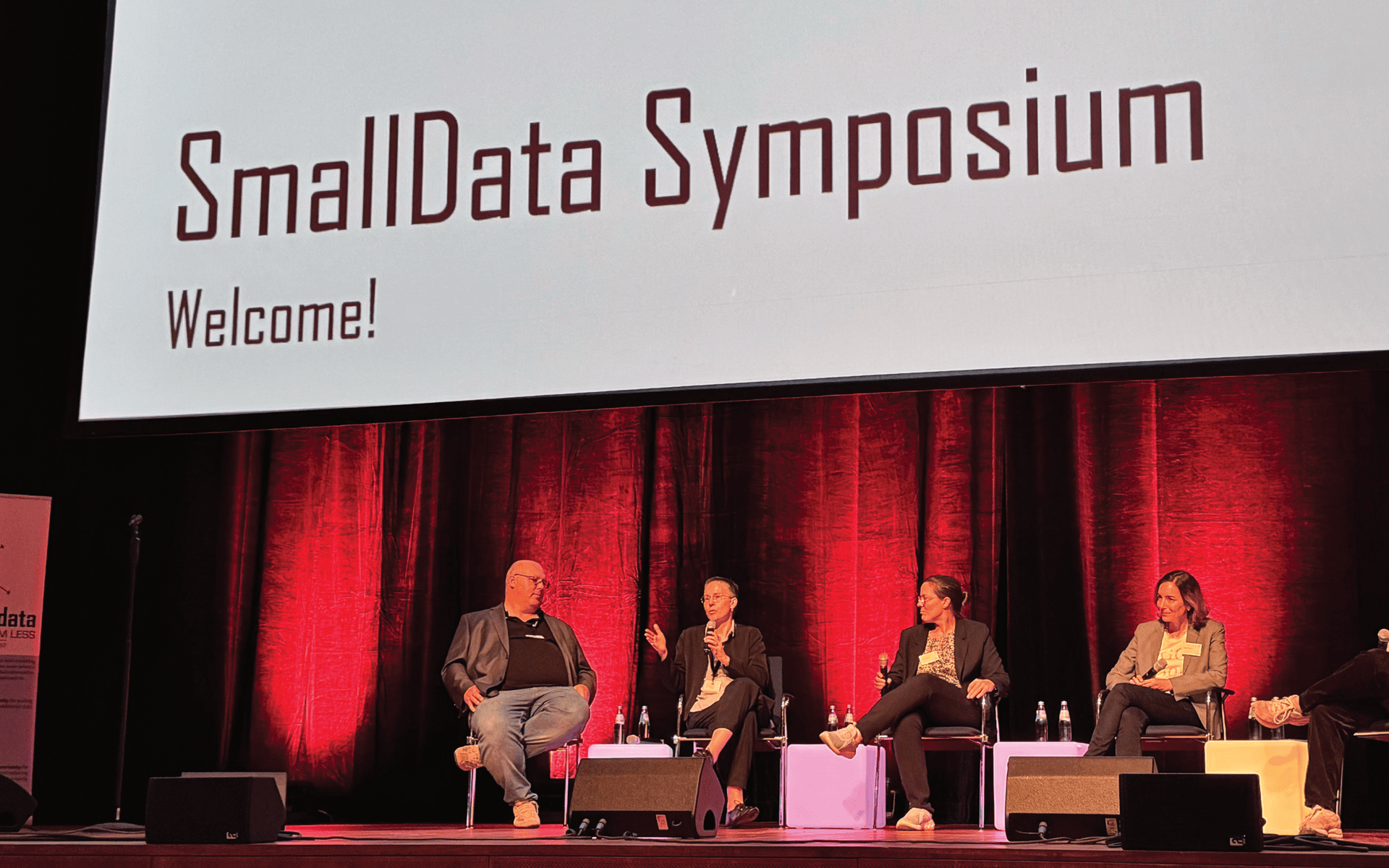
On October 1, members of the CRC Small Data and international researchers came together for the SmallData Symposium 2026, organized in collaboration with ISCB GMDS 2026.
Our spokesperson, Harald Binder, welcomed participants and shared his vision for the future of small data research, before introducing our doctoral researcher Max Behrens, who chaired the first session: Similarity.
The session opened with a presentation by our PI Nadine Binder and associated researcher Jan Hasenauer on AI-assisted continuous-time modelling in metastatic breast cancer. Their work addresses similarity by using language model embeddings to derive similarity-based representations of heterogeneous treatment histories to better analyse disease progression in breast cancer patients. Associated researchers Maria Kalweit and Evelyn Ullrich followed with their research on modelling NK cell cytotoxicity. Here, similarity is captured through latent interaction states learned from microscopy sequences. These latent representations organize NK cell trajectories into interpretable behavioural modes, and allow similar temporal interaction patterns to be identified even under sparse supervision. The session closed with a panel discussion in which our experts explored how similarity is addressed in their respective fields of work, showing the role that expert knowledge plays in modeling systems, and the importance of communication with domain experts.
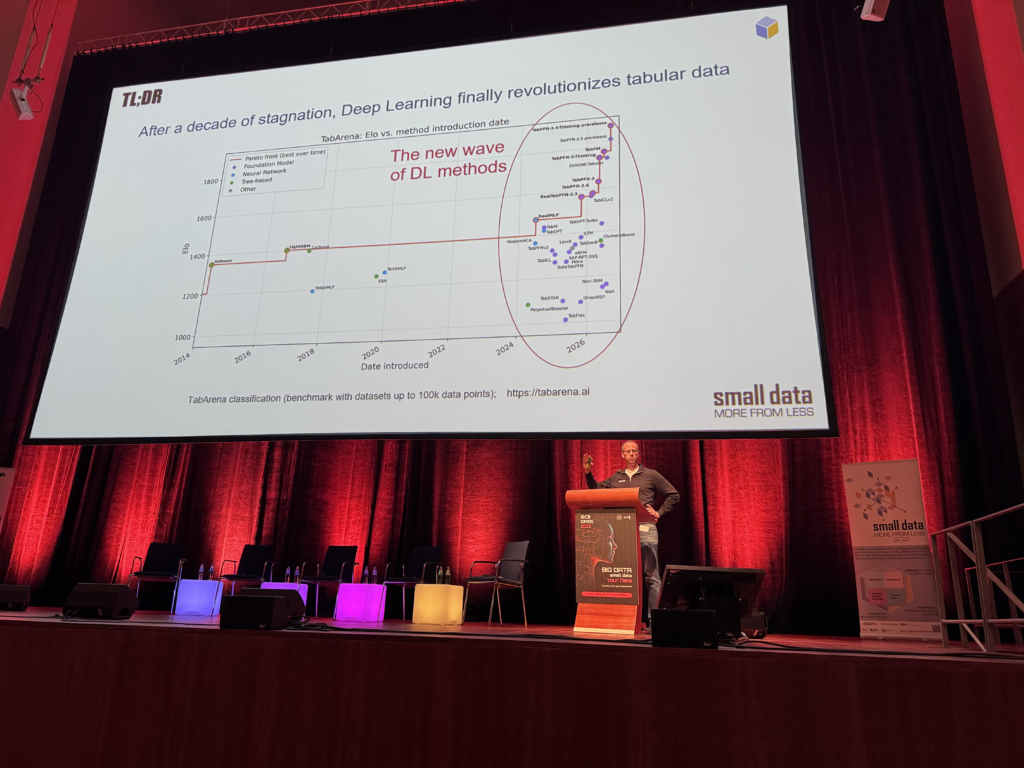
Our doctoral researcher Julia Hindel chaired the second session: Transfer. Here, our PI Frank Hutter and associated researcher Pascal Schlosser discussed the use of tabular foundation models in longitudinal data situations, and introduced a new survival foundation model built on nanoTabPFN. In this research, the transfer aspect lies in learning from synthetic survival datasets and applying this knowledge to new real world datasets without the need for dataset specific training. Our PIs Anna Köttgen and Johannes Hertel then showcased their work on whole body metabolic models and the potential to transfer knowledge from these large scale models to more specific, cell specific representations, particularly of the kidney. Our doctoral researchers then took the stage for a series of flash presentations, showcasing their own small data research. Our thanks go to Nils Kolber, Adrian Fritz, Hanning Yang, Jelena Bratulić, Sebastian Walter, Carola Heinzel, and Fabian Kabus for their presentations!
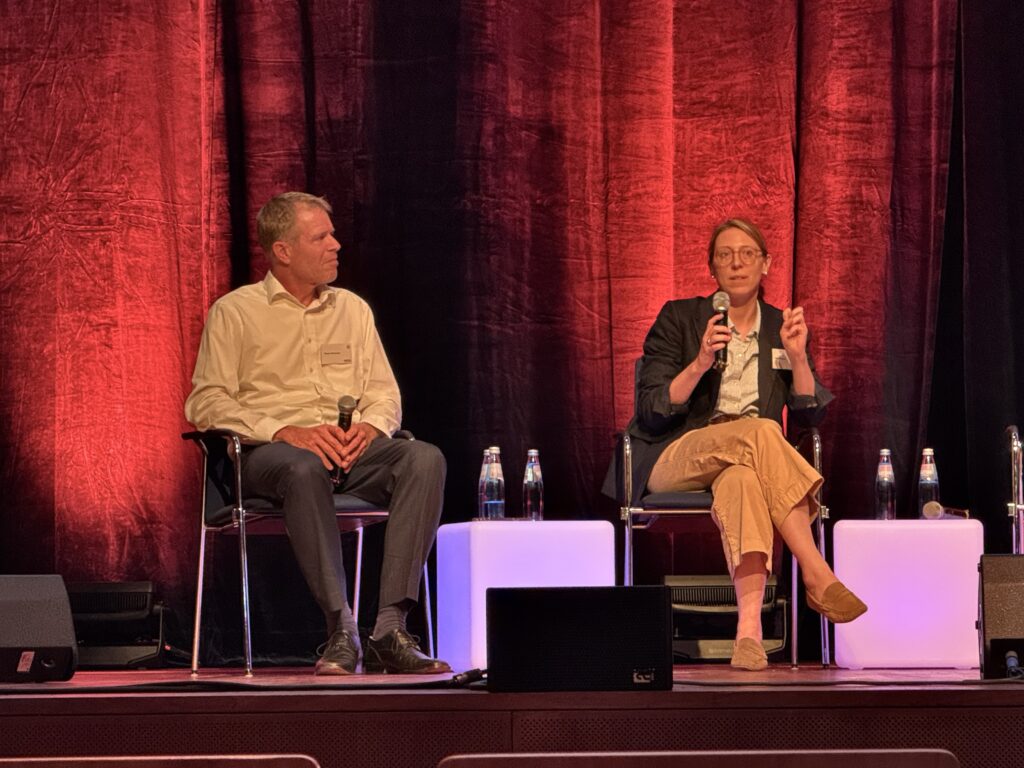
After the lunch break, our doctoral researcher and session chair Carola Heinzel welcomed the audience to the final session: Uncertainty. Our associated PI Heinz Wiendl presented his joint work with fellow associated researcher Susanne Weber on modelling disease progression in multiple sclerosis. Here, he focused on the uncertainty involved in translating complex clinical disease patterns into statistical models, and on how different modelling choices can lead to different representations of disease progression. Our associated researchers Maria Elena Maccari and Martin Wolkewitz then moved from neurological disease to rare paediatric diseases, with a specific focus on uncertainty in causal models, which is particularly important in paediatric settings, where patient cohorts are small. Maria Elena and Martin were then joined on stage by our PI Peter Pfaffelhuber and invited guest Sibylle Frase for a panel discussion on navigating uncertainty, both from a methodological and a clinical perspective. The discussion highlighted the value of early collaboration in developing models that are both methodologically sound and clinically useful.
We would like to thank all our speakers for their outstanding contributions and all attendees for their engaged participation. Special thanks to the ISCB GMDS 2026 Conference organizers for making this collaborative event possible!
Institute of Medical Biometry and Statistics,
Faculty of Medicine and Medical Center –
University of Freiburg